
How to Find Redlands Residents
A name search and an address search begin in different places. An assessed parcel can identify the owner on the roll and separate a physical situs from a tax-mailing address. A deed index can show grantors, grantees, document types, and dates. A court docket can connect a party to a case, while a vital-record application may produce an informational or authorized copy under a different rule. For family history, the Heritage Room and printed directories often add the spouse, occupation, address, or community group that a modern index leaves out.
Use a short trail, and keep each result tied to its source. Start with the county property search if an address or parcel is known. Use California’s voter tool only for a person’s own status unless an approved voter-file purpose applies. Move to the recorder when a transfer, lien, or earlier owner matters. For a former household, pair a dated owner with a city directory, census schedule, obituary, or probate file. A Redlands residents directory is a map of these trails, not one master roll.
- Enter the physical address, parcel number, or owner name in San Bernardino County govPIMS, then save the APN and distinguish situs from mailing data.
- Open the City of Redlands GIS parcel layer to check the parcel, city boundary, sphere of influence, ZIP, and nearby service layers.
- Use the recorded-document index for grantor and grantee names, then match the legal description before treating a same-name result as the same land.
- For a current self-check, use My Voter Status. For earlier people, pair directory years with the 1930, 1940, or 1950 census and local newspapers.
- If the record is not online, ask the custodian for a focused copy or inspection request instead of asking an office to create a new list.
Redlands Resident Records Offices
Redlands is in San Bernardino County but is not the county seat. That distinction matters. Deeds, assessment records, county vital certificates, and most trial files lead to San Bernardino rather than Redlands City Hall. City-created permits, council records, police records, and public requests stay with Redlands. A reliable Redlands residents directory therefore starts with custody: ask the city for a city record, ARC for a county record, the Superior Court for a case, and CDPH for a statewide vital record.
The San Bernardino County Assessor-Recorder-County Clerk combines recorder, assessor, and clerk functions. The recorder index is a party index, the assessor ties parcel facts to an assessed owner, and the clerk handles marriage, fictitious business name, and related filings. The County Registrar of Voters administers election records, but California makes broad voter-file access purpose based. The city’s public-records page supplies a separate route for existing municipal records.
San Bernardino County Recorder-Clerk
222 W. Hospitality Lane, 1st Floor
San Bernardino, CA 92415-0022
909-387-8306
San Bernardino County Assessor
222 W. Hospitality Lane
San Bernardino, CA 92415
909-387-8307
County Registrar of Voters
777 East Rialto Avenue
San Bernardino, CA 92415
909-387-8300
The county recorder image above is an access point, not proof that every document can be read online. The web index and the instrument itself are separate steps. For an office-level starting point, ARC’s records page explains the index, copy orders, mail route, and appointments.
The ARC official-records page shows the county’s recorder and copy-access route. It is a useful reminder that Redlands research often ends at a San Bernardino counter when an image or certified copy is needed.
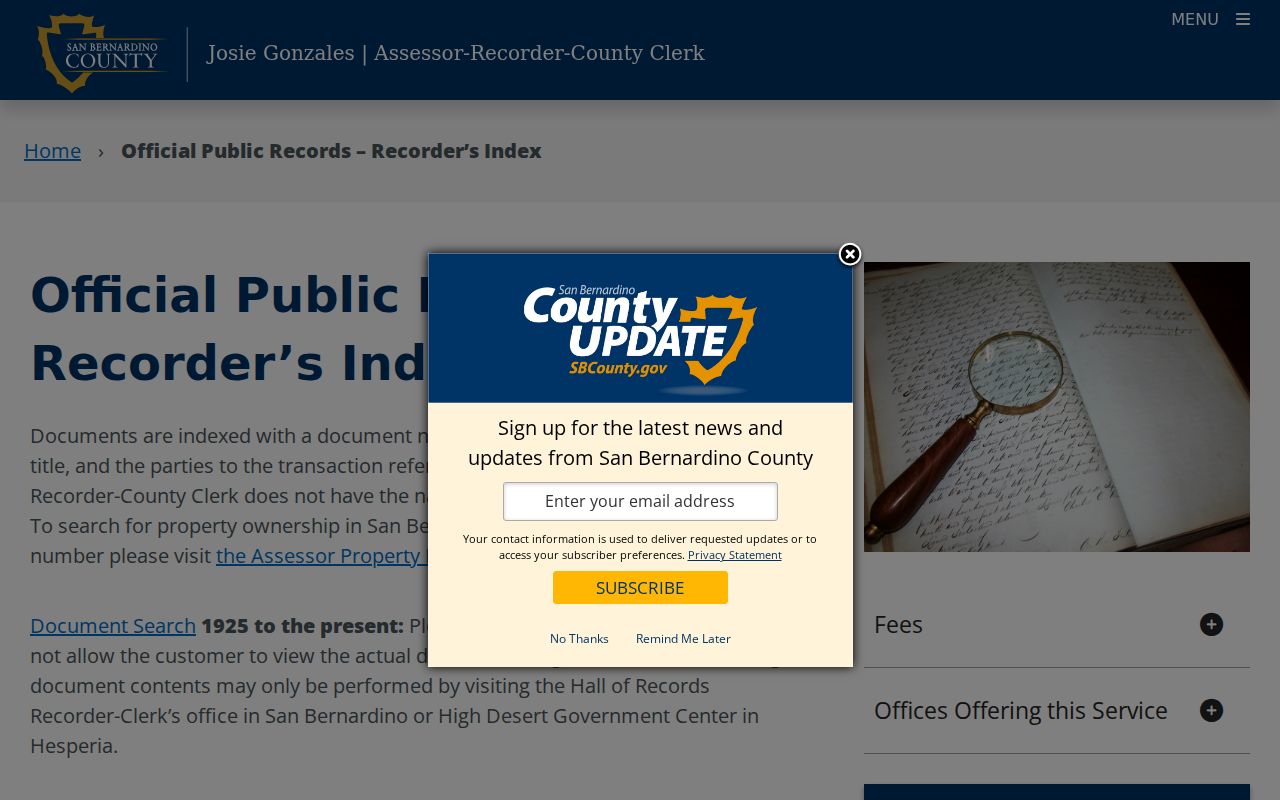
The page describes an index and order path rather than a searchable roster of everyone in Redlands. Keep the document number, date, parties, and legal description when moving to the next source.
Redlands Resident Property Search: APN, Address and Owner
The govPIMS Assessor’s Parcel Access application has three documented ways to locate a parcel: Parcel Number, Address Search, and Owner Search. An APN is the assessor’s stable parcel identifier. A situs address is the physical location of land or a building. An owner mailing address is where an assessment notice goes. The last two can differ, and neither field alone proves who sleeps at the property.
Search by the physical address when the street is known. Search by owner name when the purpose is to find property connections, but preserve the spelling used by the assessment roll. A trust, business, or estate can be named instead of an individual. The official guide says a successful search centers the map and fills a Search Information panel. It also describes reporting and export functions after a parcel is located. ARC does not perform special queries, so do not present the portal as a custom household list.
The assessor parcel-search capture shows the public launch point for APN, address, and owner modes. Use Chrome or Firefox as the county recommends, then record the APN before following a deed or permit trail.
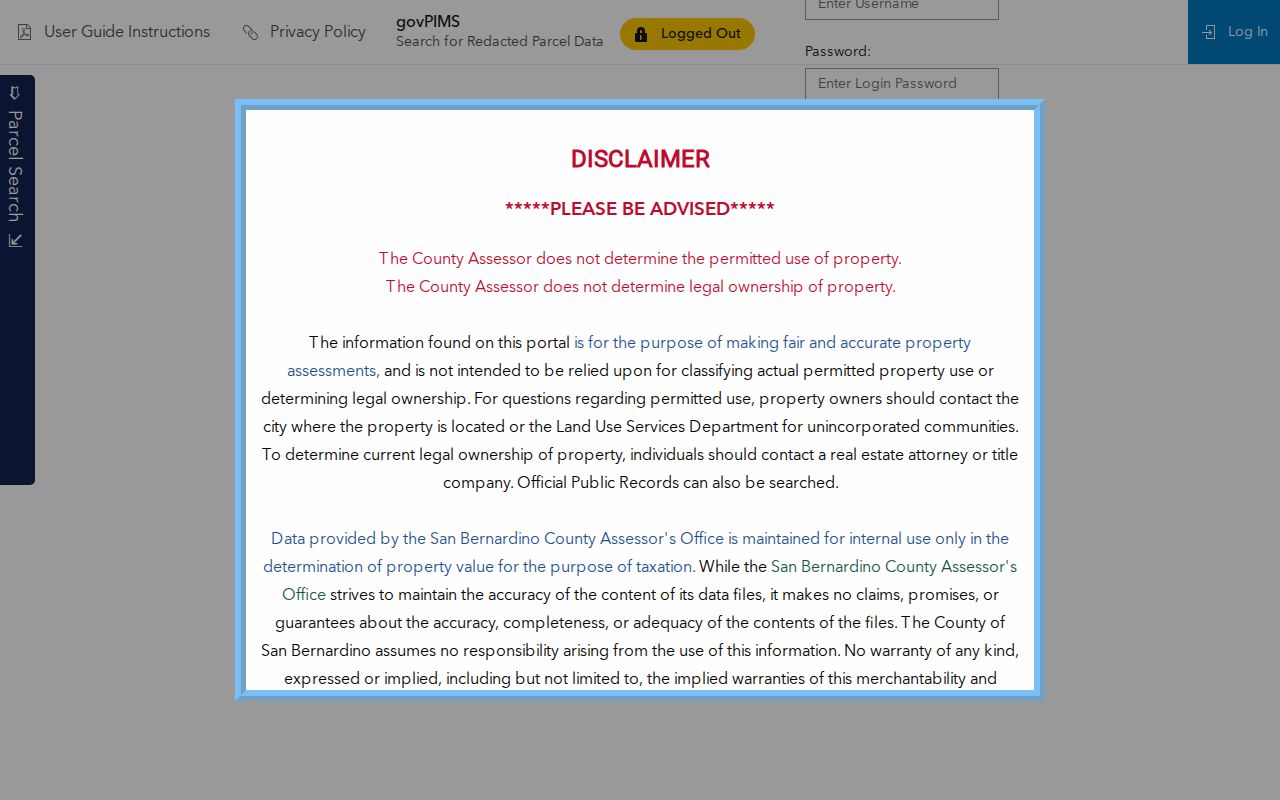
The search modes anchor property evidence to a parcel. They do not create a current occupant roll, and assessed ownership is not the same as adjudicated title.
| govPIMS control | What it means in Redlands |
|---|---|
| Parcel Number | Enter the full APN, the unique assessor identifier described in the county guide. |
| Street Number and Street Name | Address mode searches the situs or physical address, not the owner mailing address. |
| Owner Name | Search the name as the assessment roll records it; a trust or entity may be the named owner. |
| Search Information | The map centers on the located parcel and the information panel populates after a match. |
| APN Properties and reporting | Optional deeper analysis and export controls after selection; current display limits should be checked in the live tool. |
- Parcel
- A mapped unit of land identified by an APN, with legal and assessment fields that can bridge an address to an official record.
- Situs address
- The physical location of the parcel. It is not the same as an owner’s mailing address.
- Roll
- An assessment list maintained for property administration. It is evidence about assessed ownership and value, not a household census.
- Index
- A finding aid that points to a record. An index entry is not the full deed, case file, or certificate.
Redlands Residents and the Recorder Index: Parties, Not Addresses
The ARC Official Records page says its public document search covers 1925 to the present. The county property-research guide describes its online grantor-grantee chain workflow as 1958 to the present. Those statements may describe different search components. Treat the distinction as a coverage question, not as a clean universal cutoff, and ask Recorder staff at 909-387-8306 when a pre-1958 trail matters.
The Recorder self-service portal starts with a reCAPTCHA and an I Accept control. The documented index fields are Grantor, Grantee, document number, document date or range, and document title or type. It is like a library card catalog. It is not an address search and it does not display deed contents online. Instrument viewing is handled at the Hall of Records or High Desert Government Center under the access limits described in the research.
The county self-service index page pairs with the official entry point above. Read a party result as a lead, then compare the legal description, parcel, date, and role before connecting it to a Redlands property.
Copies can be ordered online or by mail. The posted schedule lists $4 for the first page, $1.50 for each later page, and $1.50 per page for a seal. Online card payments add 3.5 percent. Mail orders normally return in one to two weeks, and map copies are sold only at the Hall of Records. An appointment is strongly encouraged. These are copy-access facts, not a claim that an online result proves residency.
Current Redlands Resident Directories
No lawful public source lists every person living in Redlands. The useful current records are narrower. Some identify an assessed owner, some show a recorded party, some let a voter authenticate their own registration, and city proceedings may name an applicant, speaker, official, or property owner. The table keeps those roles separate so a searcher does not turn one kind of directory into a claim it cannot support.
| Source | What it can show | Keeper | Access |
|---|---|---|---|
| govPIMS parcel access | Assessed owner, APN, situs and mailing clues, property facts | San Bernardino County Assessor | Free public search |
| Recorder public index | Grantors, grantees, document type, date, and document number | San Bernardino County ARC | Free index; images by office or order |
| My Voter Status | One voter’s own status, county, precinct, and election information | California Secretary of State | Authenticated self-lookup |
| Redlands city records | Names in council files, permits, police records, and existing city documents | City Clerk and departments | Laserfiche, portal, or CPRA request |
| Heritage Room and eLibrary | Historical names, addresses, occupations, notices, photographs, and oral histories | A.K. Smiley Public Library | Appointment or licensed library access |
Current directory work is strongest when two sources agree on a time and place. The assessed owner can be compared with a recorded instrument. A business filing can corroborate an occupation, but it does not establish a home. A city permit can mark a project at an address, but it does not create a resident roster. When the question narrows to one person, the Redlands resident lookup page keeps identity anchors and access limits in one workflow.
Redlands Resident Voter Status and Addresses
My Voter Status is an authenticated self-service tool, not an open Redlands street roll. Its visible identity fields are first name, last name, date of birth, and conditional California driver license or identification number and last four Social Security digits. A successful personal lookup may report registration status, party preference, county, polling place, vote-by-mail status, and election information. It does not reveal a neighbor’s record or ballot choice.
The California voter-status page shows why the tool belongs in a self-check workflow. Never enter another person’s sensitive identity data to test a guess.
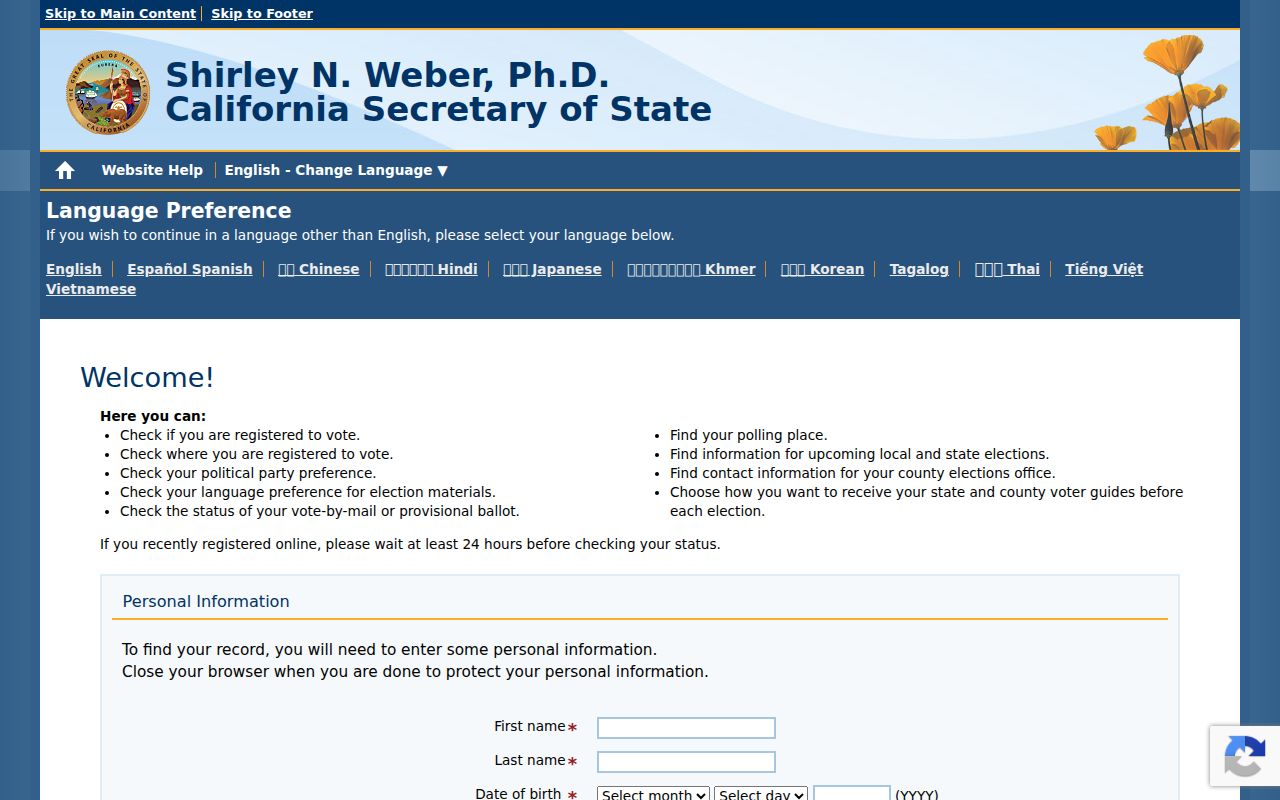
Other-voter data requires a qualifying election, scholarly, journalistic, political, or governmental purpose, an application, identification, fee, and security plan. Participation history reports a method of voting, never a selected candidate or measure. Confidential registrations and Safe at Home participants are excluded from ordinary public display. The phrase “public voter roll” therefore needs a purpose and custody qualifier in any Redlands residents directory.
Redlands City Records Through CPRA
Redlands’ public-records route covers existing city documents. A request can go through NextRequest, email to recordsrequest@cityofredlands.org, mail to City of Redlands, Office of the City Manager, P.O. Box 3005, Redlands, CA 92373, in person at the City Clerk’s Office, 35 Cajon Street, Suite 2, or verbally at a department. Written requests work best when they name the record type, a date range, an address or parcel, and the desired format.
The city says it will provide records or acknowledge a request no later than the tenth day after receipt, though production can take longer. The California Public Records Act, Government Code Division 10, sections 7920.000 through 7931.000, reaches identifiable nonexempt records and direct duplication costs. It does not require Redlands to create a new resident list, answer a research question, or conduct legal research. The city’s public-records guidance states that public records are provided without charge, while certified county and state records have their own fees.
Redlands public-records request information is the source for these routes. The captured city page below shows where a municipal request begins.
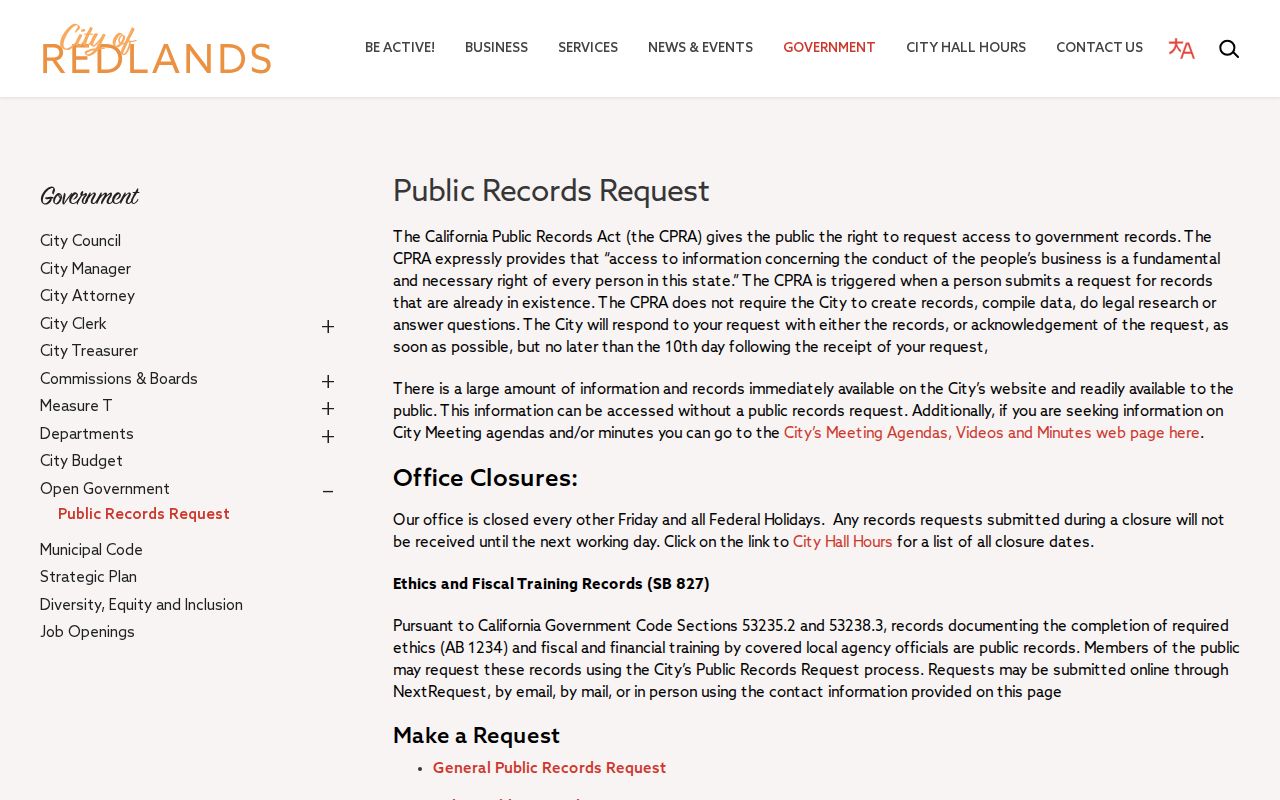
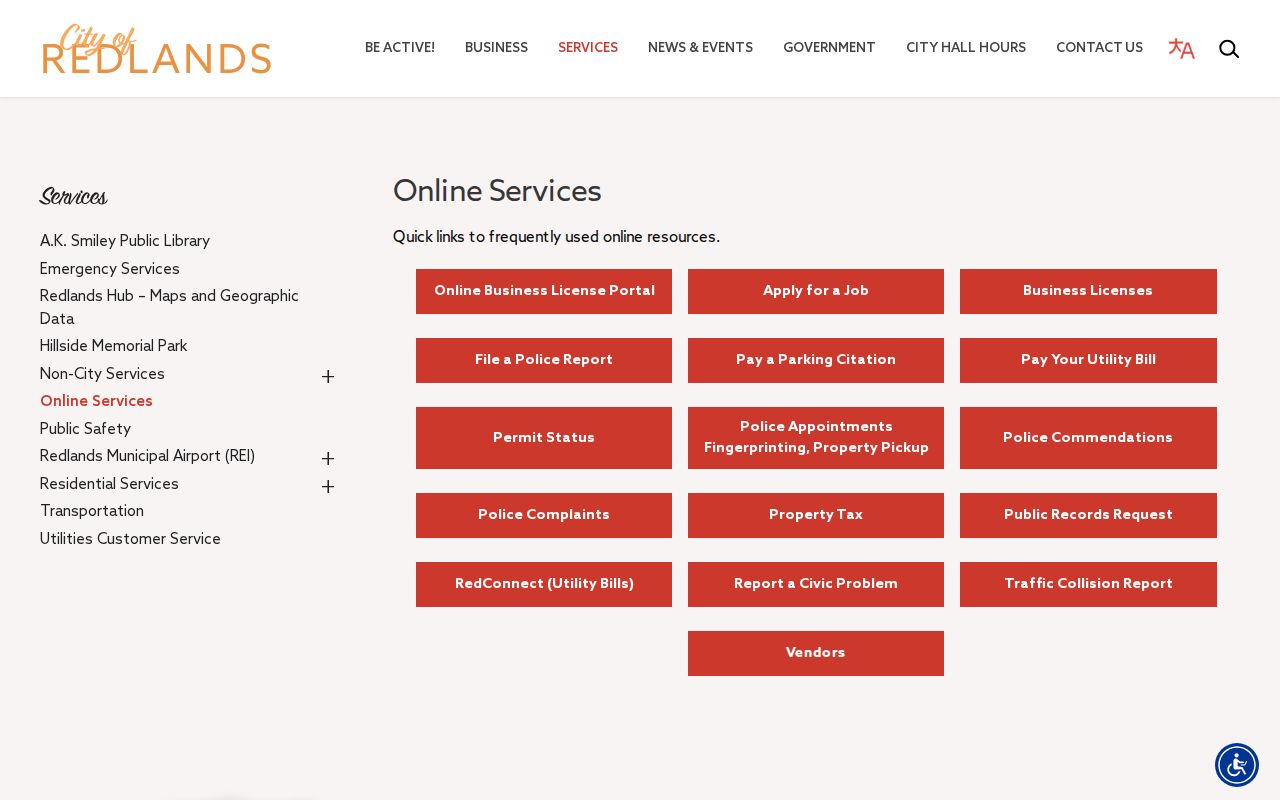
The City Clerk’s Laserfiche WebLink interface can browse, search, retrieve, download, and print council-approved documents. If too many users are connected, NextRequest is the fallback. Building Safety also exposes permit status by permit number and a permit-type filter, but the complete interactive address and result fields were not verified. The Redlands online services directory helps separate permits, business licenses, public records, and other city functions.
The city service-directory capture places the municipal systems in context. A permit or council file can name a person connected to an address without proving that person currently lives there.
Police records use a separate request channel and may be redacted. Deeds, marriage certificates, probate, and most court records belong elsewhere.
San Bernardino Court Records for Redlands Names
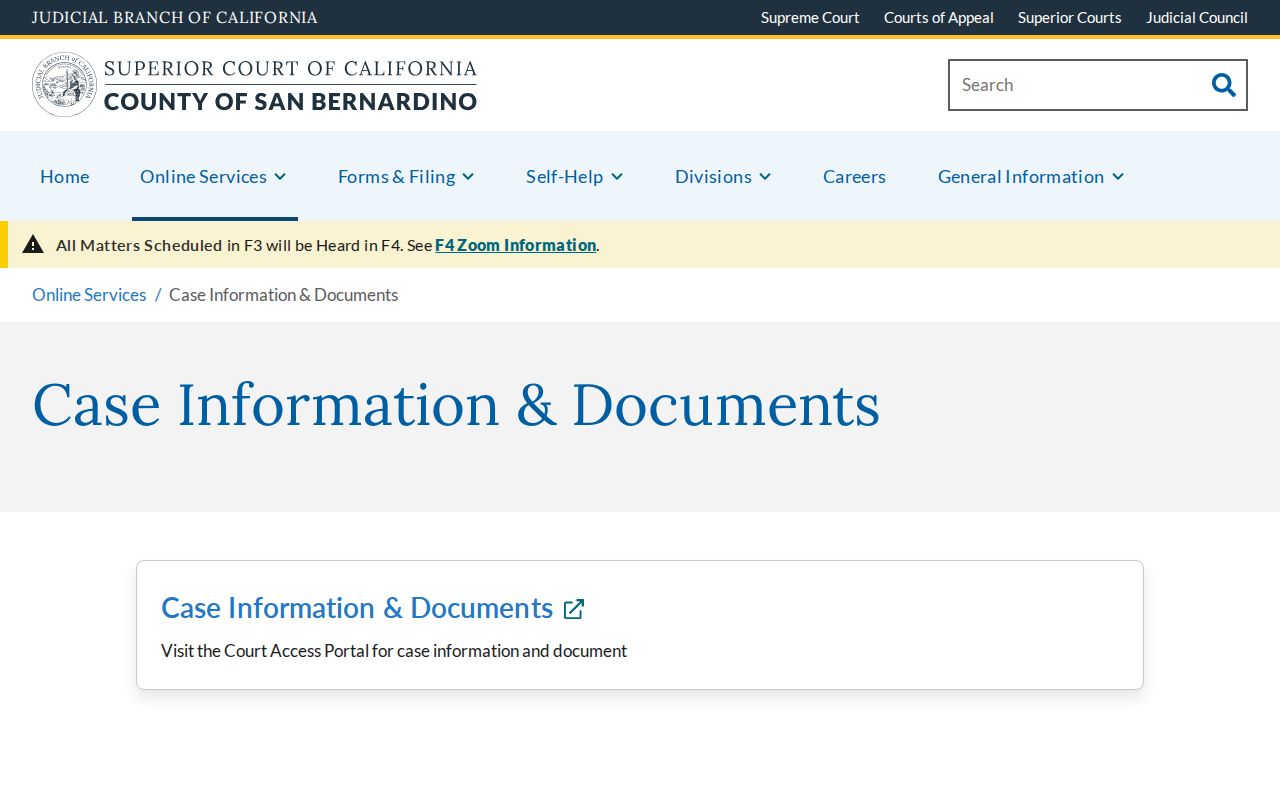
Redlands has no separate municipal court for ordinary state trial matters. The Superior Court of California, County of San Bernardino, serves the relevant case districts. The Court Access Portal begins after terms are accepted and can expose basic case data for civil, criminal, family, probate, and other configured matters. Pre-1998 case data may be limited.
The court access capture shows the correct entry point for a Redlands case search. A civil image that is eligible for remote viewing costs $0.50 per page. A public docket does not make every attachment remotely viewable. Confidential, sealed, juvenile, adoption, and restricted family-law material may require the courthouse that has jurisdiction.
The San Bernardino Justice Center criminal division is at 247 W. Third Street, San Bernardino, CA 92415-0240, phone 909-384-1888, with public and service hours Monday through Friday, 8 to 4. For an older or non-imaged file, quote the party name, approximate year, case type, and district to the clerk. PACER covers federal cases only and is not a statewide substitute.
- Docket
- A court’s running case record, with party and filing information that may be more limited than the complete file.
- Public image
- A scanned document allowed for the access channel being used. A document can be public at a counter but withheld from remote display.
- Certified copy
- A copy issued under the custodian’s certification process. A web result or ordinary image is not automatically certified.
Redlands Vital Records and Informational Copies
For a Redlands event, San Bernardino ARC handles births and deaths that occurred in the county and marriage licenses purchased there. CDPH-Vital Records maintains the statewide birth, death, fetal death or stillbirth, marriage, and dissolution record products. A full divorce decree belongs to the Superior Court. California uses an authorized versus informational copy distinction under Health and Safety Code sections 103525 and 103526 rather than one simple genealogy opening date.
The county vital-record route lists a birth fee of $34, death $26, and marriage $19 effective July 1, 2026. The state fees effective January 1, 2026 are birth $31, death $26, marriage $19, and dissolution $18. An informational copy can be available to an applicant who is not eligible for an identity-valid authorized copy, but it carries a warning that it cannot establish identity. Confidential marriage certificates are limited by Family Code section 509, and adoption records have separate seals.
The county vital-record page connects the fee and eligibility route to the actual custodian.
County mail forms ask for record type, copies, names, event date and place, parents where relevant, applicant contact details, relationship or eligibility, purpose, sworn statement, notarization where required, and payment. The county retains a search fee when no record is found. CDPH uses its own forms and payment rules, so a Redlands residents directory lead should never be treated as the certificate itself.
Redlands Heritage Room and Historical Clues
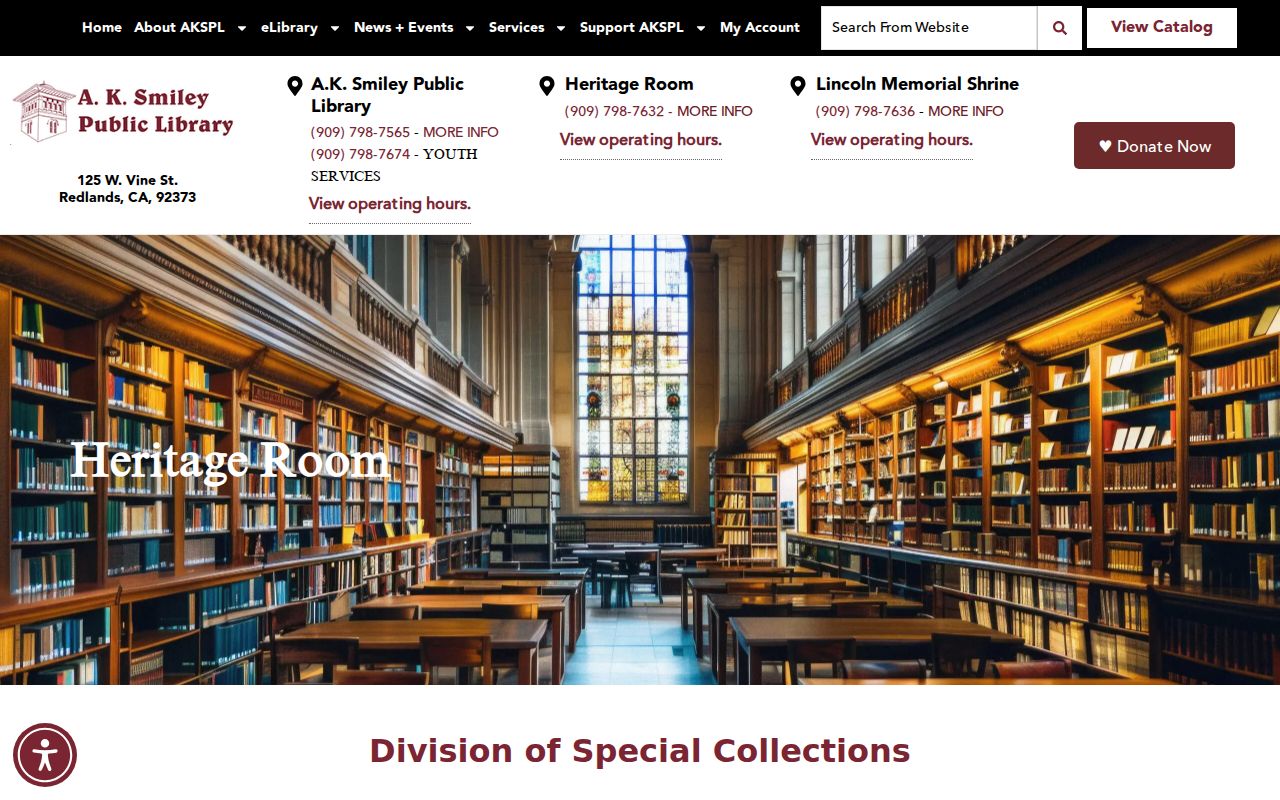
A.K. Smiley Public Library’s Heritage Room, at 125 W. Vine Street, is the strongest offline complement to modern Redlands records. It is open Tuesday through Saturday from 10 to 12 and 1 to 5, closing for lunch. Appointments are encouraged, and an online request is not final until staff confirms it. Researchers can call 909-798-7632 or email heritage@akspl.org. Pens are prohibited, and the Researcher Policy governs handling, copying, and publication.
The Heritage Room page points to the local collection rather than a generic genealogy shelf.
Holdings include the City of Redlands Collection, California Collection, rare books, pamphlets and ephemera from the 1860s forward, maps from the 1850s forward, photographs, manuscripts, and more than 100 oral histories. “Citrus & Service” and “Citrus, Labor, and Community in East San Bernardino Valley” help restore names and experiences that an ownership roll misses.
The local newspaper shelf is unusually useful. The Citrograph has an index for 1887 to 1896. Redlands Daily Facts runs from 1890, Redlands Daily Review runs from 1901 to its 1919 merger, The Colored Citizen covers 1905 to 1906, and El Amigo del Hogar supplies Spanish-language community evidence around the turn of the century. The eLibrary offers Ancestry Library Edition on library computers or Wi-Fi, Fold3 Library Edition for military records, and authenticated newspaper tools.
The library eLibrary supplies licensed genealogy, military, and newspaper access. These databases are access channels, not replacements for the underlying county, state, court, or archival custodian.
Historical Redlands Resident Directories
The verified digitized volume is the 1936 Redlands (California) city directory, a 402-page FamilySearch Digital Library item that also names Mentone, Loma Linda, Bryn Mawr, and the Yucaipa Valley. It includes a buyers’ guide and a complete classified business directory. That geography is a warning: “Redlands” in a title can describe a publisher’s service area, not a strict city-limit roster.
Additional Redlands city and reverse-directory years were not exposed on the inspected Heritage Room page. Ask staff for catalog titles and the abbreviation key rather than inventing a publisher run. A directory entry may pair a surname with a given name or initial, spouse, occupation, address, and household marks, but the exact symbols in a volume must be checked against that volume’s key. For a deeper reading workflow, use the Redlands directory book page.
Redlands Directory History Across Three Institutions
Record age changes the best place to search. San Bernardino County began in 1853. Redlands incorporated in 1888. A.K. Smiley Public Library opened in 1898 and the Heritage Room was established as an archives in 1972. The University of Redlands, founded in 1907, adds catalogs, yearbooks, photographs, and organizational records. The State Archives offers collection-level descriptions rather than one universal Redlands name index, while the National Archives provides released federal census schedules.
A printed directory, a yearbook, an obituary, and a parcel record can each support a time-and-place match without proving current residence. Search a surname in more than one spelling, add an occupation or school year, and write down the address and date that made the match persuasive. A disappearance may mean death, marriage or name change, military service, relocation, boundary change, or an omitted entry.
Use the library, university, museum, and historical society for context and finding aids. Their private membership lists are not assumed to be public, while their published catalogs and yearbooks can supply useful time-and-place clues.
Redlands Privacy and Lawful Resident Research
Public availability has limits. Assessed owners may live elsewhere. Renters, household members, utility customers, and DMV address records do not become a public Redlands residents directory. California voter information is purpose restricted, and Safe at Home participants can keep a qualifying address out of public display. Government Code section 7928.205 and other redaction rules may remove names or addresses from public-facing records.
The Safe at Home program supplies a substitute mailing address and confidential mail forwarding for qualifying survivors and protected participants. A resident who needs protection should use the official enrollment and demand process, not assume a broker opt-out erases a deed or court file.
The Safe at Home page shows the state privacy program that sits beside, not inside, the ordinary resident-search tools.
Lawful use. Use Redlands records for personal, lawful research, family history, civic understanding, or a house-history question. Do not use an address or name to stalk, harass, threaten, or intimidate anyone. California stalking and electronic-harassment laws can apply even when the starting record was lawfully available.
Redlands Records in a Changing Digital Year
Several recent changes affect how a Redlands residents directory should be checked. San Bernardino County reported a Parcel Fabric modernization in May 2026 that converted and validated more than 21,000 assessor map pages across more than 820,000 parcels. Better map layers still do not decide legal title or occupancy. The recorder index, assessor parcel, legal description, and original instrument remain separate evidence.
California’s Delete Request and Opt-out Platform, called DROP, began mandatory broker deletion processing on August 1, 2026. A resident can send one encrypted request to more than 500 registered data brokers, but deletion of a commercial profile does not delete the government deed, business filing, or other lawful source beneath it. Keep confirmations and verify any response through the official program.
The California DROP capture shows the statewide privacy route for downstream commercial profiles.
County officials also warned in April 2025 that deceptive lien letters quoted real recorded facts to look official and demand payment. Verify a document number, lien, or copy fee with ARC before paying anyone. Accurate public-record details are not proof that a sender is a government office.