
How to Find Redlands Residents
Name and address searches start in different rooms. An assessed parcel names the owner on the roll. It splits a physical situs from a tax-mailing address. A deed index lists grantors, grantees, document types, and dates. A court docket ties a party to a case. A vital-record application can yield an informational copy. It can also yield an authorized copy, and each falls under its own rule. For family history, the Heritage Room adds the spouse, occupation, address, or club that a modern index skips. Printed directories do the same.
Keep the trail short and each result tied to its source. With an address or parcel in hand, start at the county property search. Use California's voter tool only for your own status unless an approved voter-file purpose applies. Move to the recorder for transfers, liens, and prior owners. Chasing a former household pairs a dated owner with a city directory. A census schedule, obituary, or probate file helps too. The pieces vary. A Redlands residents directory is a map of these trails, not one master roll.
- Enter the physical address, parcel number, or owner name in San Bernardino County govPIMS, then save the APN and distinguish situs from mailing data.
- Open the City of Redlands GIS parcel layer to check the parcel, city boundary, sphere of influence, ZIP, and nearby service layers.
- Use the recorded-document index for grantor and grantee names, then match the legal description before treating a same-name result as the same land.
- For a current self-check, use My Voter Status. For earlier people, pair directory years with the 1930, 1940, or 1950 census and local newspapers.
- If the record is not online, ask the custodian for a focused copy or inspection request instead of asking an office to create a new list.
Redlands Resident Records Offices
Redlands sits in San Bernardino County but is not the county seat. That distinction shapes every records hunt. Deeds, assessment records, and county vital certificates lead to San Bernardino. Most trial files lead there too, not Redlands City Hall. Permits, council records, police records, and public requests stay with the city. Custody comes first. Ask the city for a city record, ARC for a county record, and the Superior Court for a case. Ask CDPH for a statewide vital record.
The San Bernardino County Assessor-Recorder-County Clerk merges three roles. The recorder keeps a party index. The assessor ties parcel facts to an assessed owner. The clerk handles marriage, fictitious business name, and related filings. The Registrar of Voters administers election records, though California makes broad voter-file access purpose based. Redlands' own public-records page offers a separate route for municipal files.
San Bernardino County Recorder-Clerk
222 W. Hospitality Lane, 1st Floor
San Bernardino, CA 92415-0022
909-387-8306
San Bernardino County Assessor
222 W. Hospitality Lane
San Bernardino, CA 92415
909-387-8307
County Registrar of Voters
777 East Rialto Avenue
San Bernardino, CA 92415
909-387-8300
A county recorder image is only the first step. The web index and the document itself remain separate steps. Many searches end at a San Bernardino counter before a certified copy is in hand. That is the practical shape of Redlands research. For an office-level starting point, ARC’s records page lays out the index, copy orders, the mail route, and how to book an appointment.
The ARC official-records page is the county’s recorder and copy-access route in one place. Think of it as the doorway to the deed, parcel, and property rolls. Those records back up any residents directory lookup.
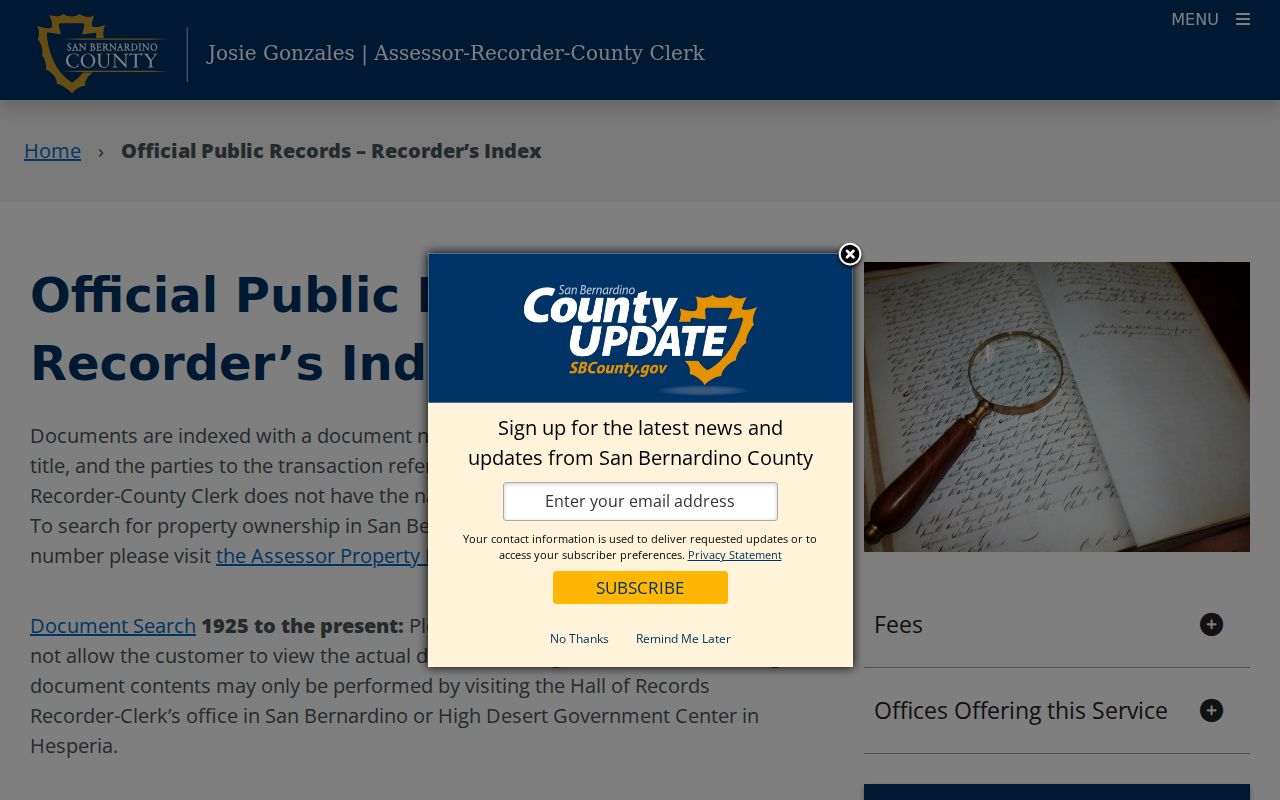
The page is an index and an order path, not a roster of everyone in Redlands. No resident roll hides here. Record the document number, date, parties, and legal description before moving to the next source.
Redlands Resident Property Search: APN, Address and Owner
The govPIMS Assessor’s Parcel Access application offers three ways to find a parcel. You can search by Parcel Number, by Address, or by Owner. Each mode answers a different question. An APN is the assessor’s stable parcel identifier. A situs address marks the physical land or building. An owner mailing address is simply where the assessment notice goes. The last two can differ, and neither field alone proves who sleeps at the property.
Search by the physical address when the street is known. Search by owner name when the goal is tracing property connections. But keep the spelling the assessment roll uses. A trust, business, or estate may appear instead of a person’s name. The official guide notes that a successful search centers the map. It also fills a Search Information panel. It describes reporting and export functions once a parcel is located. ARC does not perform special queries, so the portal is not a custom household list.
The assessor parcel-search entry page is the public launch point. It serves APN, address, and owner modes. Use Chrome or Firefox, as the county recommends. Then record the APN before following any deed or permit trail. The number anchors every later lookup in the residents directory.
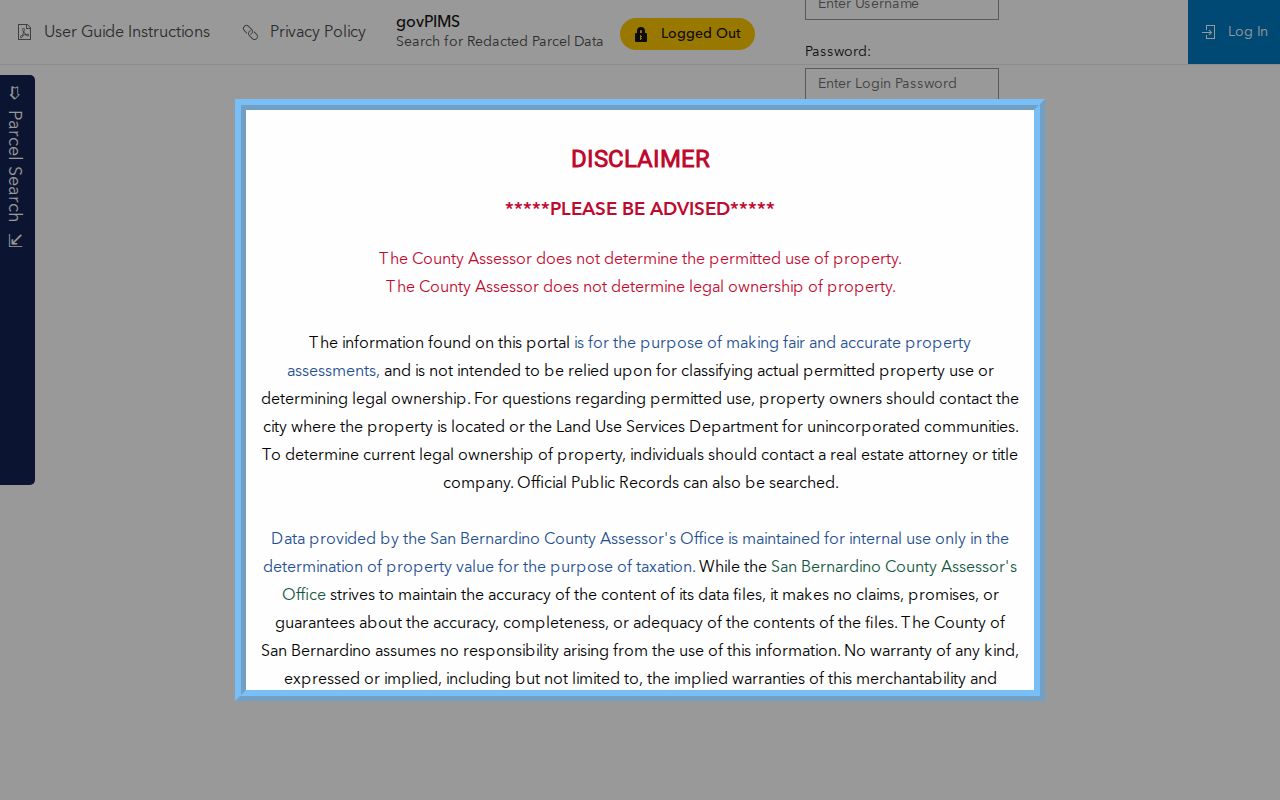
The search modes anchor property evidence to a parcel. They build no current occupant roll, and assessed ownership is not adjudicated title.
| govPIMS control | What it means in Redlands |
|---|---|
| Parcel Number | Enter the full APN, the unique assessor identifier described in the county guide. |
| Street Number and Street Name | Address mode searches the situs or physical address, not the owner mailing address. |
| Owner Name | Search the name as the assessment roll records it; a trust or entity may be the named owner. |
| Search Information | The map centers on the located parcel and the information panel populates after a match. |
| APN Properties and reporting | Optional deeper analysis and export controls after selection; current display limits should be checked in the live tool. |
- Parcel
- A mapped unit of land identified by an APN, with legal and assessment fields that can bridge an address to an official record.
- Situs address
- The physical location of the parcel. It is not the same as an owner’s mailing address.
- Roll
- An assessment list maintained for property administration. It is evidence about assessed ownership and value, not a household census.
- Index
- A finding aid that points to a record. An index entry is not the full deed, case file, or certificate.
Redlands Residents and the Recorder Index: Parties, Not Addresses
The county’s Official Records search states coverage from 1925 to the present. A separate property-research guide describes the online grantor-grantee chain as reaching back only to 1958. The gap is real but not simple. Two components may carry different date ranges, so a pre-1958 trail is a question for Recorder staff at 909-387-8306 rather than a clean cutoff.
The Recorder self-service portal opens with a reCAPTCHA and an I Accept control. From there it works like a card catalog. The index fields are Grantor, Grantee, document number, document date or range, and document title or type. There is no address search. Deed contents are not displayed online. Instrument viewing happens at the Hall of Records or the High Desert Government Center under the standard access limits.
The county self-service index page sits alongside that entry point as its official companion. Treat any party result as a lead, nothing more. Compare the legal description, parcel, date, and role before tying the result to a Redlands property.
Copies are available online or by mail. The posted schedule charges $4 for the first page and $1.50 for each later page, with a seal at $1.50 per page. Card payments online add 3.5 percent. Mail orders typically take one to two weeks. Map copies sell only at the Hall of Records, and an appointment is strongly encouraged. Those are copy-access facts. An online index hit still proves nothing about residency.
Current Redlands Resident Directories
No lawful public source lists every person living in Redlands. The useful current records are narrower by design. One identifies an assessed owner. Another shows a recorded party. Voter tools let a person verify only their own registration. City proceedings may name an applicant, a speaker, an official, or a property owner. A residents directory built from these pieces works only when each record type is kept to the role it can actually support. The table keeps those roles separate so no single source is stretched into a residency claim.
| Source | What it can show | Keeper | Access |
|---|---|---|---|
| govPIMS parcel access | Assessed owner, APN, situs and mailing clues, property facts | San Bernardino County Assessor | Free public search |
| Recorder public index | Grantors, grantees, document type, date, and document number | San Bernardino County ARC | Free index; images by office or order |
| My Voter Status | One voter’s own status, county, precinct, and election information | California Secretary of State | Authenticated self-lookup |
| Redlands city records | Names in council files, permits, police records, and existing city documents | City Clerk and departments | Laserfiche, portal, or CPRA request |
| Heritage Room and eLibrary | Historical names, addresses, occupations, notices, photographs, and oral histories | A.K. Smiley Public Library | Appointment or licensed library access |
Directory work in Redlands is strongest when two sources agree on a time and a place. Compare an assessed owner against a recorded instrument. A business filing can corroborate an occupation, but it does not establish a home. A city permit marks a project at an address without creating a resident roster. The question can narrow to one person. The Redlands resident lookup page gathers identity anchors and access limits into a single workflow. That keeps the residents directory honest about what each record proves.
Redlands Resident Voter Status and Addresses
My Voter Status is an authenticated self-service tool, not an open Redlands street roll. It asks for a first name, last name, and date of birth. It also wants a California driver license or identification number or the last four Social Security digits. A successful personal lookup can return registration status, party preference, county, and polling place. It can also return vote-by-mail status and election information. It cannot reveal a neighbor’s record. It cannot reveal anyone’s ballot choice. The tool exists for the voter alone.
The California voter-status page shows exactly why this belongs in a self-check workflow. Never enter another person’s sensitive identity data to test a guess.
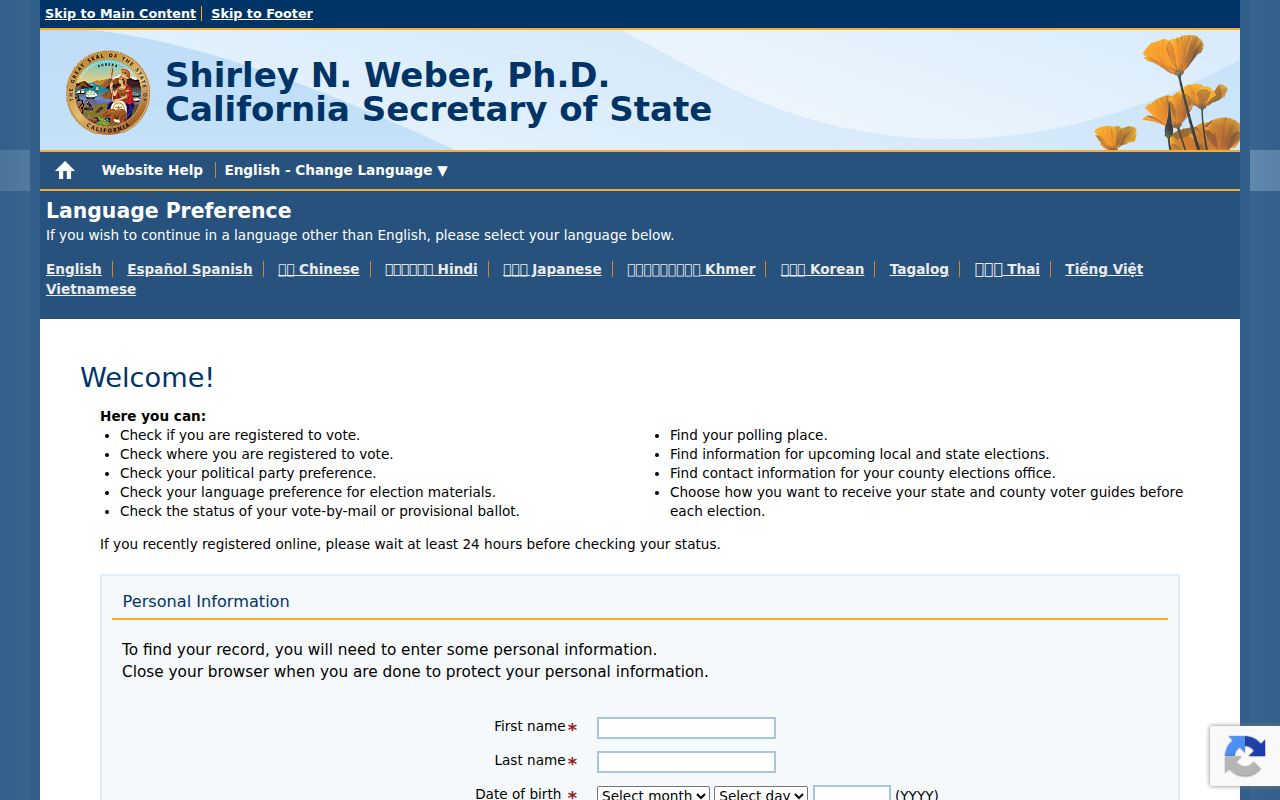
Voter data about other people sits behind real conditions. State law requires a qualifying election, scholarly, journalistic, political, or governmental purpose, plus an application, identification, a fee, and a security plan. Participation history reports a method of voting only. It never shows a chosen candidate or measure. Confidential registrations and Safe at Home participants stay out of ordinary public display. Any phrase like “public voter roll” in a Redlands residents directory therefore needs a purpose and custody qualifier before it means anything.
Redlands City Records Through CPRA
Redlands’ public-records route covers documents the city already holds. A request can go through NextRequest, by email to recordsrequest@cityofredlands.org, by mail to City of Redlands, Office of the City Manager, P.O. Box 3005, Redlands, CA 92373, in person at the City Clerk’s Office, 35 Cajon Street, Suite 2, or verbally at a department counter. Written requests work best when they name the record type, a date range, an address or parcel, and the desired format.
The city commits to providing records or acknowledging a request no later than the tenth day after receipt, though production can run longer. The California Public Records Act, Government Code Division 10, sections 7920.000 through 7931.000, reaches identifiable nonexempt records at direct duplication cost. It does not force Redlands to build a new resident list. It does not require the city to answer a research question or conduct legal research. City public-records guidance states that records are provided without charge, while certified county and state records carry their own fees.
Redlands public-records request information is the source for these routes. The official city page lays out each filing option and shows exactly where a municipal request begins.
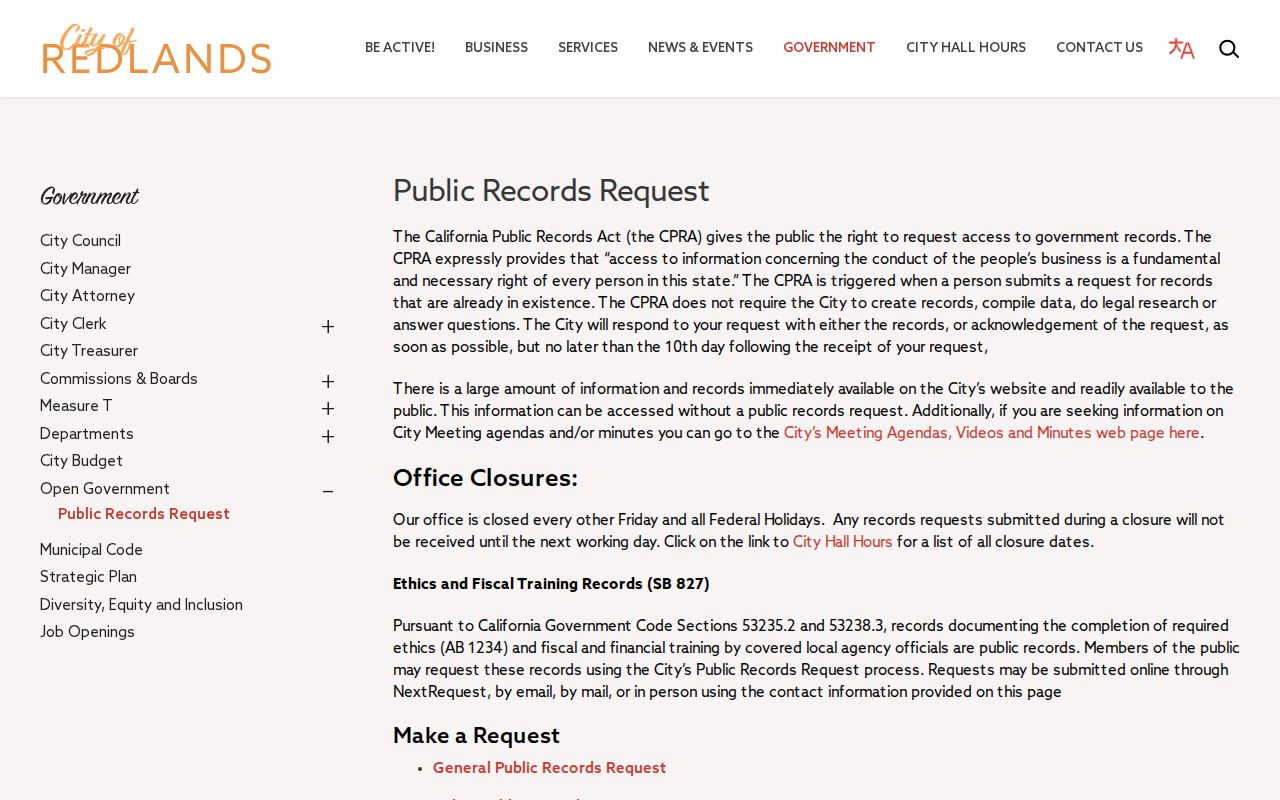
The City Clerk’s Laserfiche WebLink interface lets a visitor browse, search, retrieve, and download council-approved documents. It also supports printing. When too many users are connected, NextRequest serves as the fallback. Building Safety publishes permit status by permit number with a permit-type filter. A complete interactive address search is not part of that tool. The Redlands online services directory helps separate permits, business licenses, public records, and other city functions. It sorts those functions into distinct portals.
The city service-directory page places the municipal systems in context. A permit or council file can name a person connected to an address. It still does not prove that person lives there now.
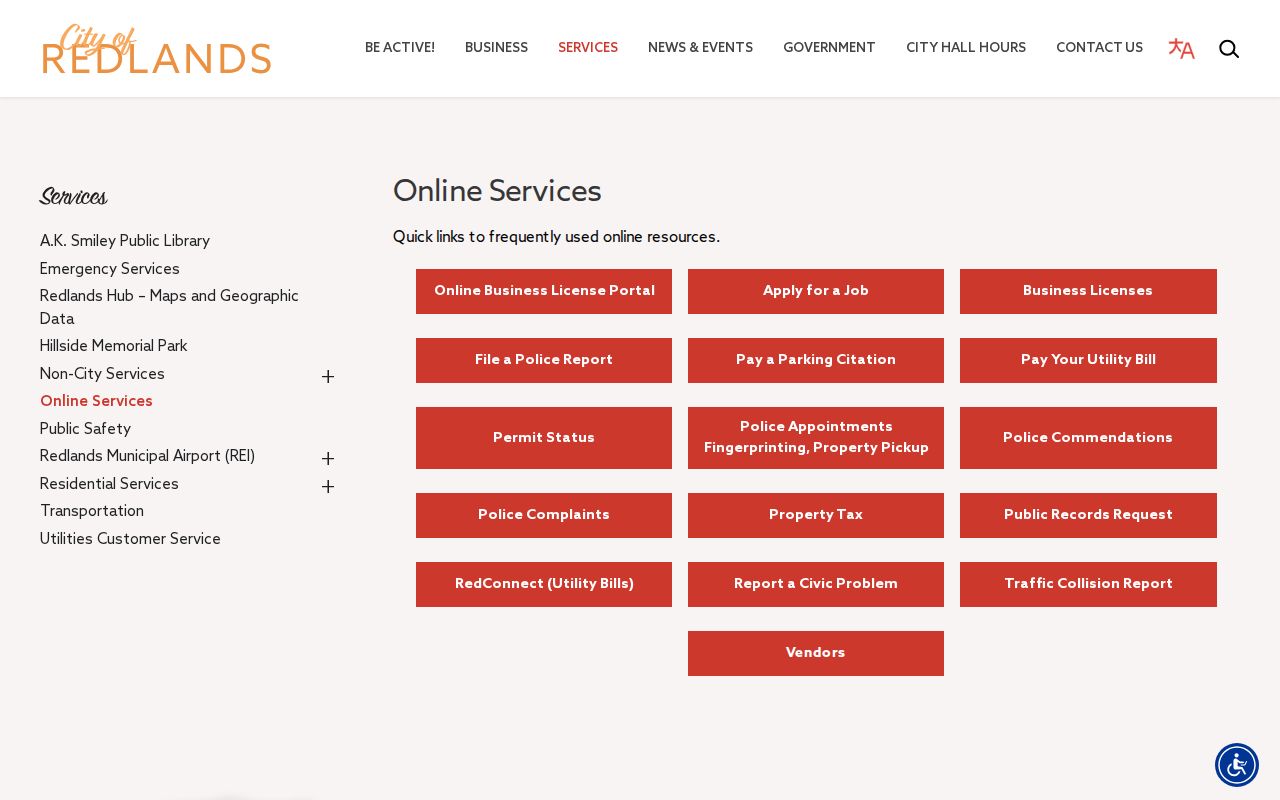
Police records move through a separate request channel and may arrive redacted. Deeds, marriage certificates, probate, and most court records all belong to other offices, not the city.
San Bernardino Court Records for Redlands Names
Redlands sends its state trial cases to the Superior Court of California. That court serves the County of San Bernardino. There is no separate Redlands municipal court for these matters. The Court Access Portal is the working entry point. It opens once a visitor accepts the terms. Civil, criminal, family, probate, and other configured case types can return basic data. Case records from before 1998 may be thin, though.
The court access page is where a Redlands case search starts. Viewing an eligible civil image remotely costs $0.50 per page. Eligible is the key word here. Sealed, confidential, juvenile, adoption, and restricted family-law files generally stay off remote view. A trip to the courthouse with jurisdiction may be the only route to them.
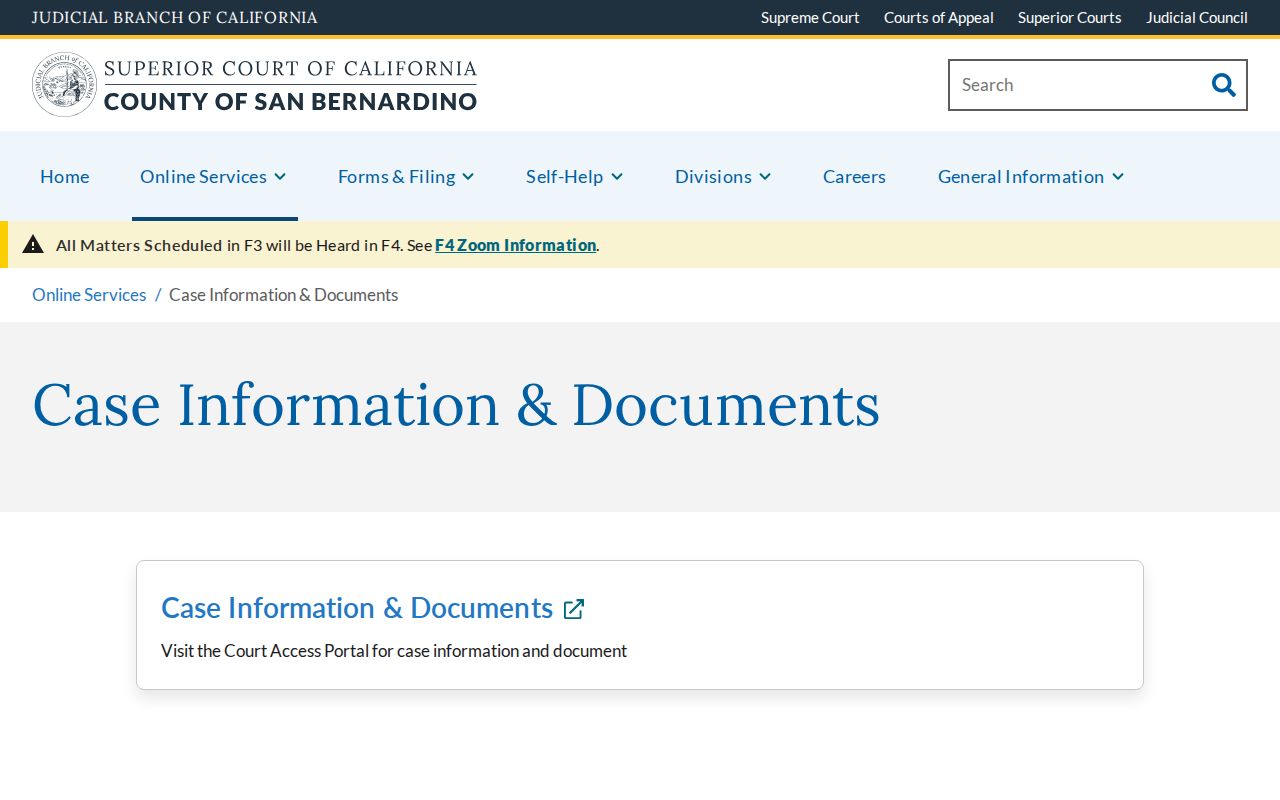
The San Bernardino Justice Center criminal division is at 247 W. Third Street, San Bernardino, CA 92415-0240, phone 909-384-1888, with public and service hours Monday through Friday, 8 to 4. For an older or non-imaged file, quote the party name, approximate year, case type, and district to the clerk. PACER covers federal cases only and is not a statewide substitute.
- Docket
- A court’s running case record, with party and filing information that may be more limited than the complete file.
- Public image
- A scanned document allowed for the access channel being used. A document can be public at a counter but withheld from remote display.
- Certified copy
- A copy issued under the custodian’s certification process. A web result or ordinary image is not automatically certified.
Redlands Vital Records and Informational Copies
A birth or death in the county, or a marriage license bought there, runs through San Bernardino ARC for Redlands events. CDPH-Vital Records keeps the statewide birth, death, fetal death or stillbirth, marriage, and dissolution products. A full divorce decree sits with the Superior Court. California splits copies into authorized and informational versions under Health and Safety Code sections 103525 and 103526, so there is no single genealogy start date.
The county vital-record route posts a birth fee of $34, death $26, and marriage $19 effective July 1, 2026. State fees effective January 1, 2026 run birth $31, death $26, marriage $19, and dissolution $18. An applicant who cannot qualify for an identity-valid authorized copy may still obtain an informational one, which carries a warning that it cannot establish identity. Family Code section 509 restricts confidential marriage certificates, and adoption records carry their own seals.
The county vital-record page ties those fees and eligibility rules to the actual custodian.
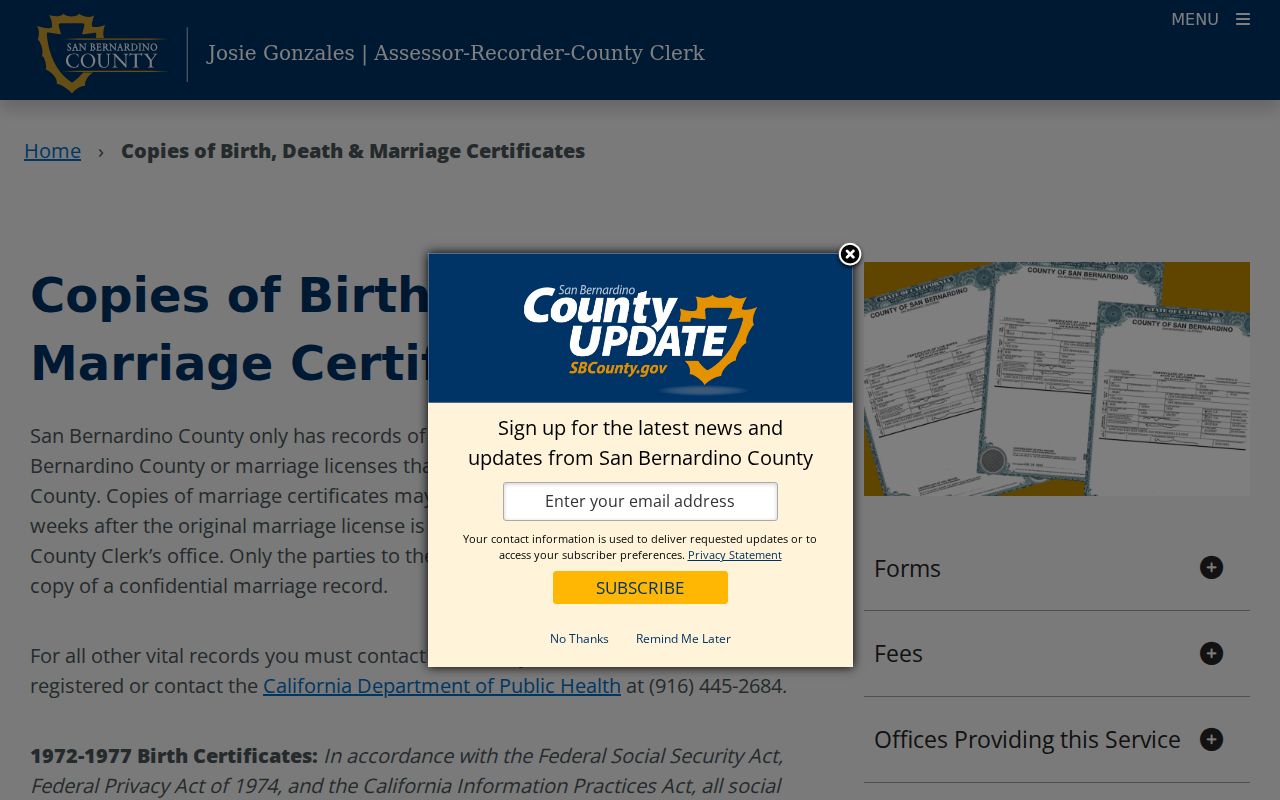
County mail forms want the record type, number of copies, names, the event date and place, parents where relevant, your contact details, relationship or eligibility, purpose, a sworn statement, notarization where required, and payment. No record found still means a search fee kept by the county. CDPH applies its own forms and payment rules. A Redlands residents directory lead is only a lead, never the certificate itself.
Redlands Heritage Room and Historical Clues
A.K. Smiley Public Library’s Heritage Room, at 125 W. Vine Street, is the strongest offline complement to modern Redlands records. Hours are Tuesday through Saturday, 10 to 12 and 1 to 5. The day includes a lunch closure. Appointments are encouraged. An online request is not final until staff confirms it. Researchers can call 909-798-7632 or email heritage@akspl.org. Pens are prohibited, and the Researcher Policy governs handling, copying, and publication.
The Heritage Room page points to a genuine local collection. It is not a generic genealogy shelf.
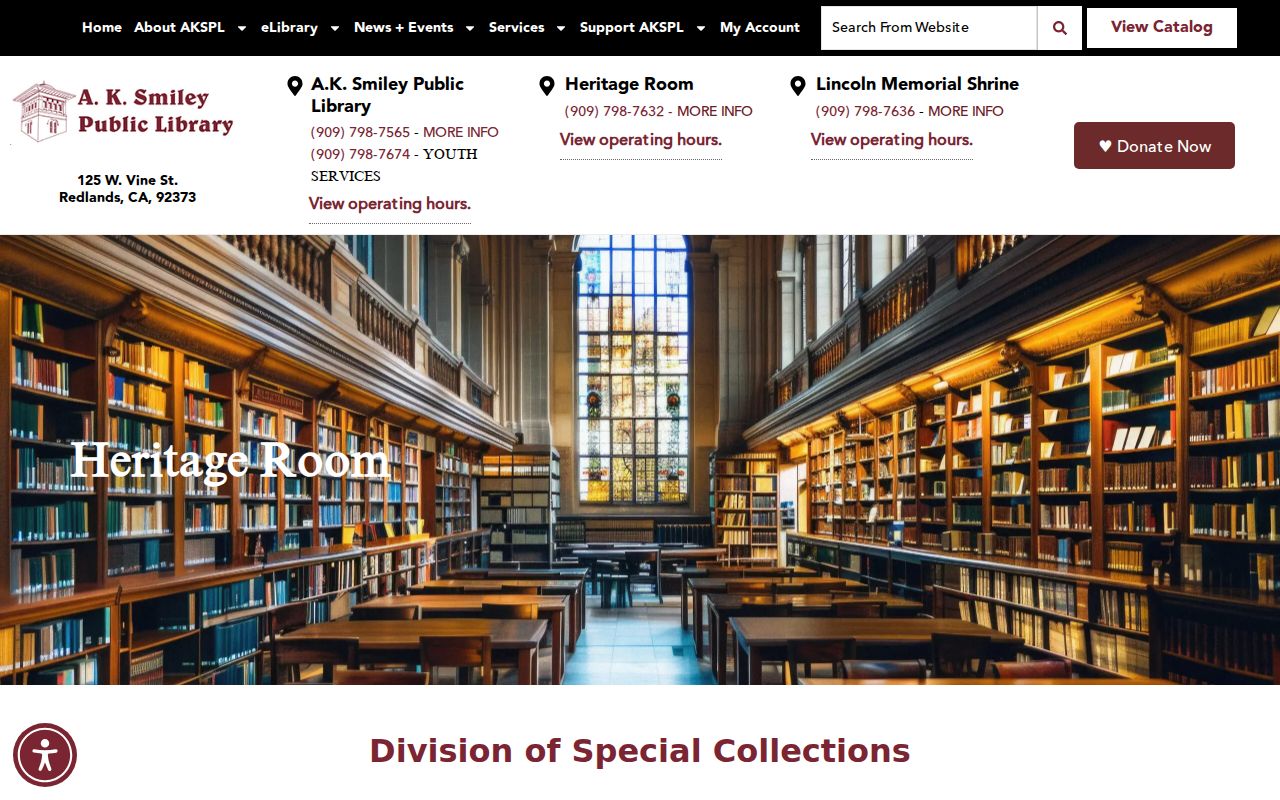
The holdings run deep. They include the City of Redlands Collection and a California Collection. Rare books, pamphlets and ephemera date from the 1860s forward. Maps go back to the 1850s. Photographs, manuscripts, and more than 100 oral histories round out the shelves. Exhibits such as “Citrus & Service” and “Citrus, Labor, and Community in East San Bernardino Valley” recover names and lives. An ownership roll alone never shows those.
The local newspaper shelf deserves special attention. The Citrograph carries an index covering 1887 to 1896. Redlands Daily Facts runs from 1890. Redlands Daily Review ran from 1901 until its 1919 merger. The Colored Citizen covers 1905 and 1906. El Amigo del Hogar adds Spanish-language community evidence near the turn of the century. Through the library eLibrary, patrons get Ancestry Library Edition on library computers or Wi-Fi, plus Fold3 Library Edition for military records and authenticated newspaper tools. Treat these databases as access channels. They are not substitutes for the county, state, court, or archival custodians behind the actual records.
Historical Redlands Resident Directories
The confirmed digitized volume is the 1936 Redlands (California) city directory. It runs 402 pages on the FamilySearch Digital Library. It also names Mentone, Loma Linda, Bryn Mawr, and the Yucaipa Valley. It carries a buyers’ guide plus a complete classified business directory. The geography matters. A title saying “Redlands” can mark a publisher’s service area. That is not always a strict city-limit roster.
The Heritage Room page lists no additional Redlands city or reverse-directory years. Ask staff for catalog titles and the abbreviation key. Do that instead of guessing at a publisher run. An entry may pair a surname with a given name or initial. It may list a spouse, an occupation, and an address. Household marks may appear too. Check the symbols against that volume’s own key before reading them. For a fuller reading workflow, the Redlands directory book page goes deeper.
Redlands Directory History Across Three Institutions
Where you search should depend on how old the trail is. San Bernardino County dates to 1853. Redlands itself incorporated in 1888. The A.K. Smiley Public Library opened in 1898. Its Heritage Room became an archives in 1972. That makes it a natural first stop for older directory volumes and local clippings. The University of Redlands was founded in 1907. It holds catalogs, yearbooks, photographs, and organizational records that often name past residents of Redlands. At the state and federal level, the State Archives describes its holdings collection by collection rather than through one master Redlands name index. The National Archives releases federal census schedules that pair well with a city directory or street directory.
No single source proves someone lived in Redlands. A printed directory, a yearbook, an obituary, and a parcel record each give a time-and-place match. Together they can be persuasive. Search a surname under more than one spelling. Add an occupation or a school year when you can. Write down the address and date that made the match hold up. When a name vanishes, the cause may be death, marriage, a name change, military service, relocation, a boundary shift, or simply an omitted entry.
For context and finding aids, lean on the library, the university, the museum, and the historical society. Their published catalogs and yearbooks supply solid time-and-place clues for any Redlands resident lookup. Treat their private membership lists as closed, though. Those rolls are not public records the way voter rolls and property rolls are.
Redlands Privacy and Lawful Resident Research
Public access has real limits in Redlands. An assessed owner may live somewhere else entirely. Renters, household members, utility customers, and DMV address files never get folded into one public Redlands residents directory. California restricts voter information by purpose. Safe at Home participants can keep a qualifying address out of public display. Government Code section 7928.205 plus other redaction rules can strip names or addresses from public-facing records before you ever see them.
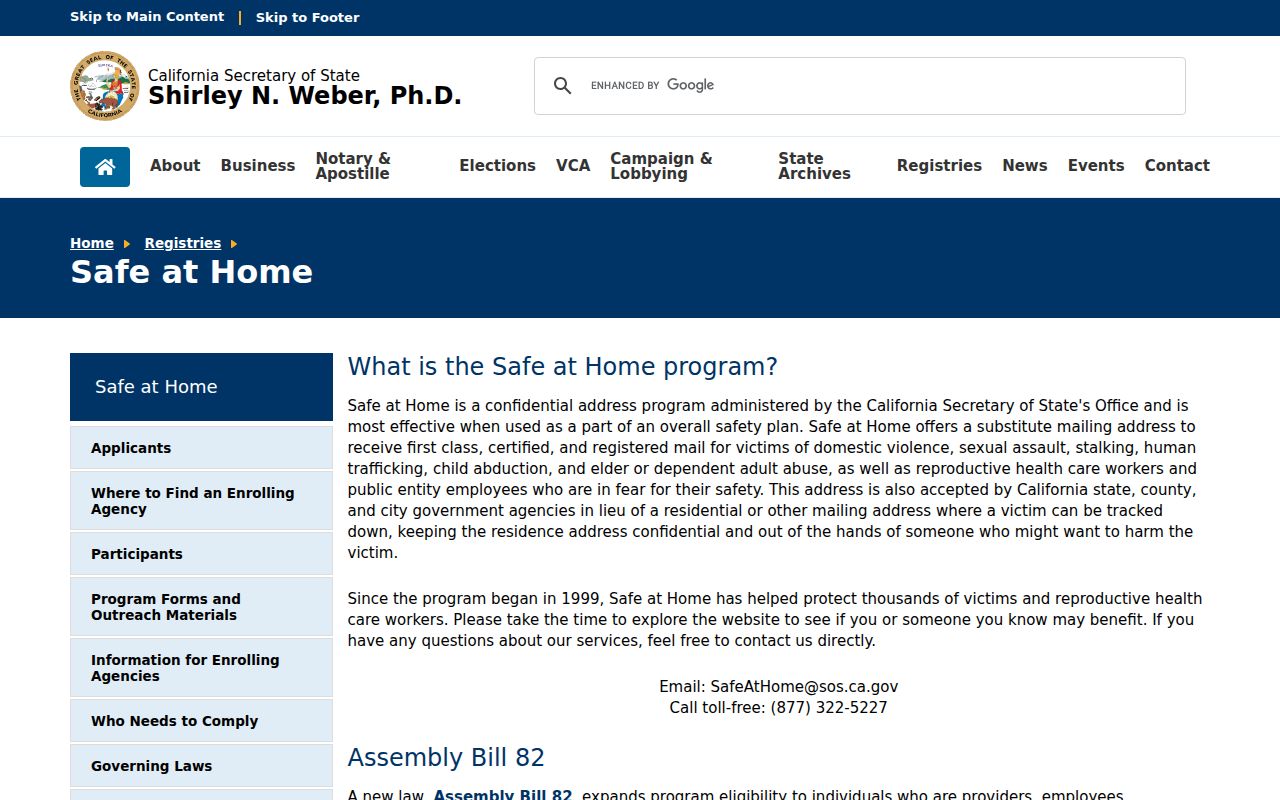
The Safe at Home program gives qualifying survivors and protected participants a substitute mailing address. It also provides confidential mail forwarding. A resident who needs that protection should enroll through the official process. Follow its demand procedures. Never assume a broker opt-out erases a deed or a court file. It does not touch the county records office at all. The Safe at Home page lays out the state privacy program that runs beside, not inside, the ordinary resident-search tools a Redlands lookup relies on.
Lawful use. Use Redlands records for personal, lawful research, family history, civic understanding, or a house-history question. Do not use an address or name to stalk, harass, threaten, or intimidate anyone. California stalking and electronic-harassment laws can apply even when the starting record was lawfully available.
Redlands Records in a Changing Digital Year
A few recent shifts change how any Redlands residents directory should be checked. San Bernardino County reported a Parcel Fabric modernization in May 2026, converting and validating more than 21,000 assessor map pages across more than 820,000 parcels. Better map layers are a genuine help for a parcel or ZIP code directory search. Still, they do not settle legal title or occupancy. The recorder index, the assessor parcel, the legal description, and the original instrument each remain separate evidence.
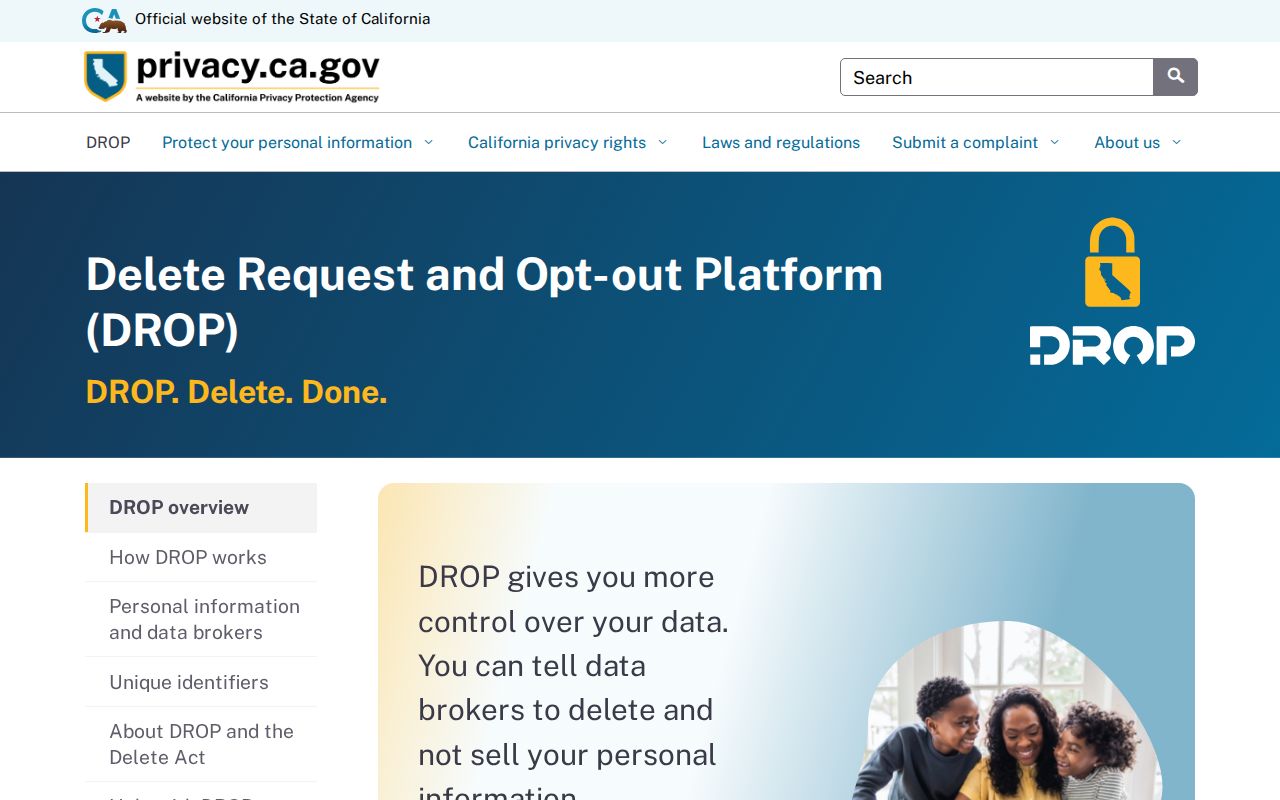
California's Delete Request and Opt-out Platform, known as DROP, began mandatory broker deletion processing on August 1, 2026. One encrypted request can reach more than 500 registered data brokers. Deleting a commercial profile does not delete the government deed, business filing, or other lawful record beneath it, so keep your confirmations and verify any response through the official program. The California DROP site shows the statewide privacy route for downstream commercial profiles, a path entirely apart from the county assessor and recorder systems a Redlands records search uses.
County officials also warned in April 2025 that deceptive lien letters quoted real recorded facts to seem official and demand payment. Check any document number, lien claim, or copy fee with ARC before paying anyone. A letter can cite accurate public-record details and still come from no government office at all.